Internal Workshops
Conducted by Southeast Asian Universities
Work Package (WP): WP7
Deliverable Number: D7.2 (also related to D15)
Expected number of workshops: 3 per institution (18 workshops total)
Expected total participants: 500 pax (including at least 50 non-academic staff)
Each Southeast Asian partner institution organized internal workshops to equip leaders, academic staff, and non-academic staff with skills tailored to their institution’s digital transformation priorities. Participation in these 18 workshops far surpassed expectations: against a target of 500 participants, a total of 3,742 individuals took part, almost eight times the expectation. Notably, non-academic staff engagement also exceeded the minimum target of 50, with 1,191 of participants recorded across institutions.
The workshops were designed to strengthen institutional readiness, enhance digital competencies, and foster pedagogical innovation in line with the project’s objectives. Sessions addressed critical themes including digital leadership, generative AI in education, instructional design, Moodle mastery, blended learning, and digital transformation frameworks. Delivered in both online and on-site formats, the workshops offered flexibility and ensured broad participation from academics, non-academics, and students alike.
|
|
|
|
|
|
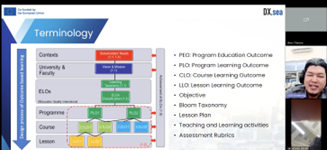
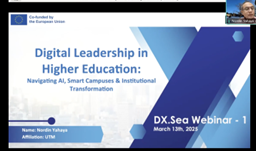
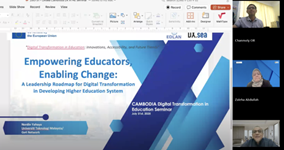
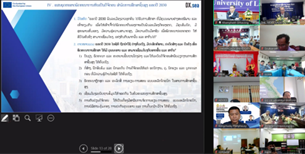
Schedule of 18 Internal Workshop Details Conducted by Southeast Asian Universities
Universiti Teknologi Malaysia (UTM)
|
No. |
University |
Date |
Workshop Title |
Venue |
Speaker(s) |
Attendance Report |
|
1 |
Universiti Teknologi Malaysia (UTM)
|
13 March 2025 (Tuesday) |
Digital Leadership |
Online |
Professor Dr. Nordin Yahaya and |
Participants: 1,228
|
|
2 |
20 March 2025 (Thursday) |
Generative AI for Teaching and Learning |
Online |
Assoc Prof Dr Nurbiha A Shukor, |
Participants: 885
|
|
|
3 |
30 April 2025 (Wednesday) |
Online Learning Engagement with Pedagogical Approaches |
Online |
Assoc. Prof. Dr. Zaleha Abdullah and |
Participants: 381
|
|
|
Universiti Malaysia Sabah (UMS) |
||||||
|
No |
University |
Date |
Workshop Title |
Venue |
Speaker(s) |
Attendance Report |
|
4 |
Universiti Malaysia Sabah (UMS)
|
20 February 2025 |
WORKSHOP 1: Artificial Intelligence Driving Academic Impact |
Online |
Dr. Chong Chou Min |
Participants: 40
|
|
5 |
26 February 2025 |
WORKSHOP 2: Digital Technology in Teaching & Learning |
UMS |
Salmie Jemon |
Participants: 37
|
|
|
6 |
17 March 2025 |
WORKSHOP 3: Elevate your Teaching Substitute Blended Learning in ITEL |
UMS |
Dr. Junainah Jaidi |
Participants: 151
|
|
|
Institute of Technology of Cambodia (ITC) |
||||||
|
No |
University |
Date |
Workshop Title |
Venue |
Speaker(s) |
Attendance Report |
|
7 |
Institute of Technology of Cambodia (ITC)
|
20 May 2025 |
WORKSHOP 1: Digital leadership |
Online |
UTM team |
Participants: 64
|
|
8 |
30 April 2025 |
WORKSHOP 2: Mastering Moodle Tools for Effective Teaching and Learning |
ITC |
Ms. SEAK Leng, Ms. CHOM Sreylam |
Participants: 39
|
|
|
9 |
19 March 2025 |
WORKSHOP 3: Workshop Title: Enhancing Digital Teaching with AI and Active |
ITC |
Mr. SOK Kimheng, Mr. BOU Channa |
Participants: 158
|
|
|
University of Heng Samrin Thbongkhmum (UHST) |
||||||
|
No |
University |
Date |
Workshop Title |
Venue |
Speaker(s) |
Attendance Report |
|
10 |
University of Heng Samrin Thbongkhmum (UHST)
|
5 May 2025 |
WORKSHOP 1: Introduction to Learning Management Systems (LMS) |
UHST |
Asst. Prof. YIN Bamnang |
Participants: 41
|
|
11 |
8 July 2025 |
WORKSHOP 2: Mastering Moodle Tools for teaching and learning |
UHST |
Assoc. Prof. Dr. PIN Tara Mr. LANG La, Mr. Thoeun Sona |
Participants: 45
|
|
|
12 |
28 July 2025 |
WORKSHOP 3: Understanding Digital Transformation |
UHST |
Assoc. Prof. Dr. Margat Chan Kit Yok, Dr. Lee Beng Yong |
Participants: 93
|
|
|
National University of Laos (NUOL) |
||||||
|
No |
University |
Date |
Workshop Title |
Venue |
Speaker(s) |
Attendance Report |
|
13 |
National University of Laos (NUOL)
|
9/4/2025 |
WORKSHOP 1: Understanding Digital Transformation |
Online |
Khamphanh Sithavong (NUOL), Dr. Ammany Nolin (DHE), Asist. Prof. Thonsouk Keomany (NUOL), Bounthong Sengvilaykham(SKU) |
Participants: 54
|
|
14 |
21-22/5/2025 |
WORKSHOP 2: Digital Infrastructure, Future Trends in Digital Infrastructure and LMS, Understanding Learning Management Systems (LMS), and Challenges and Considerations in Digital Infrastructure |
Online |
Khamphanh Sithavong, Siliphone Laviengvong (NUOL), and Mr. Nuansisavath Sombousouk (SKU) |
Participants: 187
|
|
|
15 |
6/6/2025 |
WORKSHOP 3: Online learning and Teaching with Instructional Design Models and different Pedagogical Approaches |
Online |
Khamphanh Sithavong |
Participants: 154
|
|
|
Savannakhet University (SKU) |
||||||
|
No |
University |
Date |
Workshop Title |
Venue |
Speaker(s) |
Attendance Report |
|
16 |
|
9/4/2025 |
WORKSHOP 1: Understanding Digital Transformation |
Online |
Khamphanh Sithavong (NUOL), Dr. Ammany Nolin (DHE), Asist. Prof. Thonsouk Keomany (NUOL), Bounthong Sengvilaykham(SKU) |
Participants: 85
|
|
17 |
21-22/5/2025 |
WORKSHOP 2: Digital Infrastructure, Future Trends in Digital Infrastructure and LMS, Understanding Learning Management Systems (LMS), and Challenges and Considerations in Digital Infrastructure |
Online |
Khamphanh Sithavong, Siliphone Laviengvong (NUOL), and Mr. Nuansisavath Sombousouk (SKU) |
Participants: 75
|
|
|
18 |
6/6/2025 |
WORKSHOP 3: Online learning and Teaching with Instructional Design Models and different Pedagogical Approaches |
Online |
Assoc. Prof. Dr. Phosy Chanming |
Participants: 25
|
|



Participation Breakdown (by Institution)
University |
Workshops |
Total Participants |
Female |
Male |
Academic |
Non-Academic |
Students |
Disabilities |
UTM |
3 |
2,494 |
1,446 |
1,048 |
1,465 |
1,029 |
– |
152 |
UMS |
3 |
228 |
137 |
91 |
226 |
2 |
– |
0 |
ITC |
3 |
261 |
111 |
150 |
197 |
64 |
– |
32 |
UHST |
3 |
179 |
78 |
101 |
148 |
0 |
31 |
0 |
NUOL |
3 |
395 |
128 |
267 |
328 |
67 |
– |
0 |
SKU |
3 |
185 |
81 |
104 |
156 |
29 |
– |
0 |
TOTAL |
18 |
3,742 |
1,981 |
1,761 |
2,520 |
1,191 |
31 |
184 |
Key Achievements
Exceptional Participation:
A total of 3,742 participants attended 18 workshops, almost 8 times the original target and a 648% increase over the expected 500 participants. This demonstrates strong regional commitment to digital transformation.
Gender Balance and Inclusivity:
Participation reflected strong gender representation (1,981 females and 1,761 males) and inclusivity, with 184 participants with disabilities actively involved across institutions.
Whole-Institution Engagement:
Academics and non-academic involvement was substantial, with 2,520 academics, 1,191 non-academics, and 31 students participating. UTM, NUOL, and ITC recorded particularly high non-academic engagement, indicating broad institutional uptake.
High-Demand Focus Areas:
Workshops on digital leadership, generative AI, instructional design, and Moodle mastery consistently attracted large audiences, showing strong demand for both foundational and advanced digital competencies.
Effective Hybrid Delivery:
A combination of online and on-site sessions ensured high accessibility, enabling participation across multiple campuses and countries regardless of location or resource constraints.
Recommendations
Sustain and Scale Engagement:
Formalize annual or biannual workshops to maintain momentum and support ongoing digital transformation efforts institution-wide.
Strengthen Non-Academic Capacity Building:
Given strong non-academic participation, develop targeted training for administrative, technical, and support personnel to broaden institutional digital readiness.
Expand Advanced AI Training:
Build on the strong interest in generative AI by introducing advanced, hands-on modules tailored to teaching, assessment, and administrative decision-making.
Evaluate Long-Term Impact:
Complement attendance data with longitudinal indicators such as changes in teaching practice, student learning outcomes, technology adoption, and policy development.
Maintain Inclusivity Principles:
Continue ensuring the participation of staff with disabilities and promote inclusive digital design principles across all workshop themes.
Conclusion
Across 18 workshops, the initiative recorded an impressive 3,742 participants, reflecting strong regional commitment to digital transformation. Participation was well distributed, with 1,981 females and 1,761 males, showcasing a healthy gender balance, and upheld the EU’s commitment to inclusivity by involving 184 individuals with disabilities. The consistently high demand for sessions on digital leadership, generative AI, instructional design, and learning management systems demonstrates the region’s readiness to advance digital transformation. The hybrid delivery model effectively widened access, enabling cross-border participation and strengthening institutional networks. Overall, the workshops have substantially enhanced digital competencies and laid a robust foundation for sustained digital innovation, reflecting the impact and leadership of EU-supported initiatives under the DX.sea project.